Five Democrats Who Could End John Fetterman's Senate Career

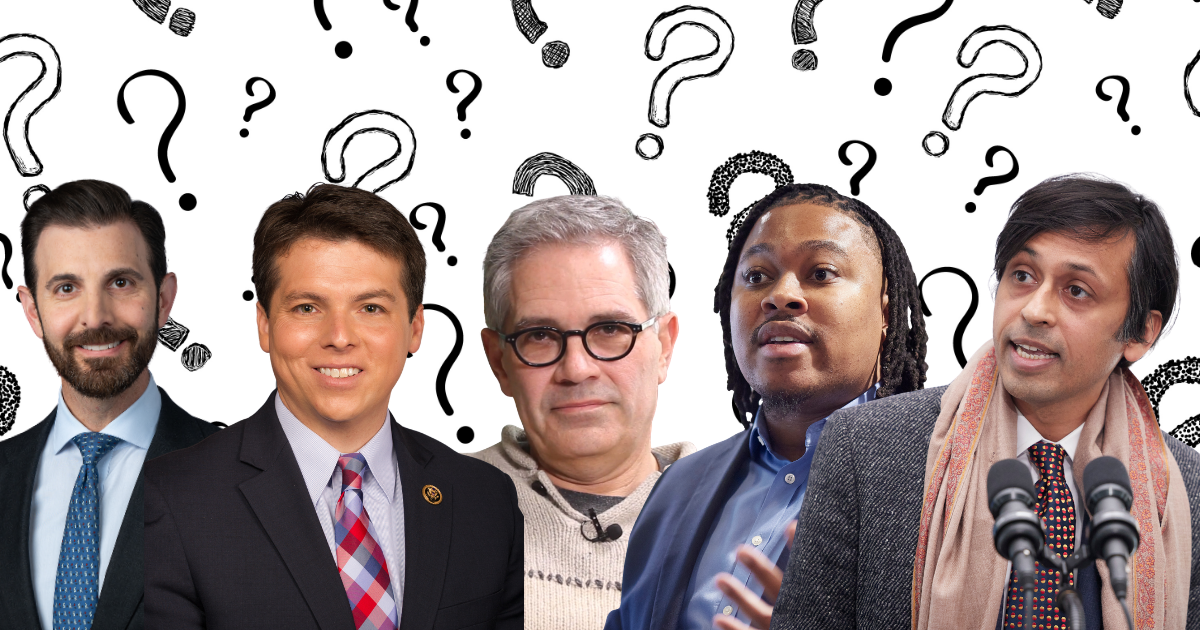
John Fetterman has a 22% approval rating among Pennsylvania Democrats.
Let that number just sit there for a second. Twenty-two percent. Among his own voters. The guy who won his Senate seat in 2022 by running as a Bernie Sanders-endorsed, hoodie-wearing populist champion of "forgotten communities" is now more popular with Republicans (62%) than Democrats in his home state. Sean Hannity, who called Fetterman "very lazy" and a "lying loser" during the campaign, has since publicly apologized and invited him onto his new podcast. Senator John Kennedy of Louisiana calls him a "total banger." Kayleigh McEnany told him on Fox News that he's "the person I would fear most" as a Democratic presidential candidate. The man has fans. They just happen to be the wrong fans if you're planning to survive a Democratic primary.
And when Spotlight PA asked Fetterman in December whether he'd even run for reelection in 2028, his response was a GIF from the Coen Brothers film A Serious Man and the words: "Accept the mystery. 2028 is gonna be crazy."
Can't argue with that.
But here's the question nobody in the Democratic primary machinery wants to ask out loud: what if Fetterman doesn't even bother showing up for the fight?
A senator with 22% approval among Democrats and 62% approval among Republicans has options that most embattled incumbents don't. He could switch parties. He could run as an Independent. He could pull a full Lieberman and lose the Democratic primary, then win the general with Republican and Independent votes, which is exactly what happened in Connecticut in 2006 when the last Democratic senator found himself this far from his own base. Pennsylvania has 1.3 million registered Independent voters. Add them to a Republican electorate that already adores him and you have a very comfortable path to reelection that doesn't require winning a single Democratic primary vote.
And the signals are there if you're watching. The Mar-a-Lago dinner. The Fox News appearances. The Republican megadonors replacing the small-dollar Democrats who left. The caucus lunch he stopped attending. The caucus group chat he quit. At what point does the man who has already left his party in every way that matters make it official? Five Democrats are lining up to primary John Fetterman. The possibility they need to reckon with is that he might not be there when they arrive.
The transformation has been swift, public, and occasionally bizarre. In October 2023, Fetterman draped himself in an Israeli flag on the National Mall and called pro-Palestinian campus protests "the Columbia pup tent intifada." In January 2025, he became the sole Democratic cosponsor of the Republican-led Laken Riley Act. Then he dined with Donald Trump at Mar-a-Lago, the first sitting Democratic senator to visit since the election, which is not the kind of record most Democratic senators are dying to hold. He's since voted to confirm ten Trump cabinet nominees, including casting the deciding committee vote to advance Markwayne Mullin for DHS Secretary. He quit the Democratic caucus lunch. He quit the caucus group chat. Sixteen of his own former campaign staffers published an open letter calling his evolution a "gutting betrayal." Hard to spin that as a minor disagreement over messaging.
The money tells the story even louder. Small-dollar donations, the grassroots lifeblood that powered his $16 million 2022 campaign, collapsed 90.5% in three quarters. From $642,000 in Q4 2024 to $61,000 in Q3 2025. That's not a dip. That's the floor falling out. Republican megadonors have quietly filled the gap: investor Matthew Ocko dropped $24,500 across Fetterman's PACs alongside $740,000 to Republican committees. Ed Glazer spent $466,000 on campaign donations in 2025, and every single dollar went to Republican committees, except for the checks he wrote to Fetterman. You can draw your own conclusions about what that means.
Governor Josh Shapiro, the most popular Democrat in Pennsylvania, was asked on ABC's This Week whether he'd support Fetterman for reelection. His answer was pure ice: "Well, he has to decide if he's seeking re-election. I think he needs to decide if he's running, and then we'll make a decision from there." That's the kind of thing you say about someone you're measuring for a political funeral. In his memoir Unfettered, Fetterman devoted two full chapters to their feud, describing "an ugliness between us, from which we have never recovered." So the governor isn't riding to the rescue. Noted.
Meanwhile, the Working Families Party launched PrimaryFetterman.com in January 2026. They've already collected 425 candidate and volunteer sign-ups. Indivisible Pennsylvania polled 16,000 members, and 93% voted to demand his resignation. That's not a party in disagreement. That's a party in revolt.
So who actually steps up? The filing deadline is still a long way off, and nobody has formally declared. But five names keep surfacing in the hallways, on the fundraising calls, and in the political reporters' notebooks. Here's who they are, what they bring, and whether any of them can actually pull this off.
1. Brendan Boyle: The Janitor's Son with $5 Million in the Bank
Brendan Boyle was the first Democrat to say out loud what everyone else was whispering. When Fetterman cast the deciding vote to advance Markwayne Mullin's DHS nomination in March 2026, Boyle posted five words on X that landed like a grenade: "He needs to go."
That was an escalation. A big one. For over a year, the 49-year-old Philadelphia congressman had been sharpening his attacks in careful increments, the way you test the ice before you walk onto a frozen lake. When Fetterman visited Mar-a-Lago in January 2025, Boyle called it "kiss the ring" behavior. When Fetterman crossed party lines during the government shutdown, Boyle branded him "Donald Trump's favorite Democrat," a phrase he's now used publicly at least three times, which starts to feel less like a jab and more like a branding exercise. But "he needs to go" was different. That wasn't criticism. That was a campaign slogan looking for a candidacy.
And the candidacy has been hiding in plain sight for anyone who reads FEC filings. As of Q4 2025, Boyle is sitting on $4.8 million in cash on hand. For a congressman in one of the safest Democratic seats in the country, he won his last race by 50 points, that's an absurd amount of money. It's not just unusual; it's suspicious, in the best way. Most House members in non-competitive districts carry $500K to $2 million. Boyle has been stockpiling for years like a man who knows exactly where he's going. His nearest potential rival for the Senate race, Chris Deluzio, has $685,000. The gap is enormous.
When Spotlight PA asked about his 2028 plans, Boyle delivered the classic non-denial denial: "Appropriately so, I am entirely focused on my own reelection in 2026 and Democrats winning back the House in 2026. But after 2026, I don't rule anything in or out." Translation: I'm running.
The biography writes itself for a statewide pitch. Boyle's father Frank emigrated from County Donegal, Ireland in 1970 and spent his career cleaning SEPTA stations. His mother was a school crossing guard. Brendan was the first person in his family to attend college, Notre Dame on a scholarship, then a master's from Harvard's Kennedy School. After Trump's 2016 victory, he co-founded the Blue Collar Caucus in Congress, explicitly designed to reconnect Democrats with working-class voters who'd drifted right. It was prescient then. It's a full statewide platform now, the kind of origin story consultants dream about putting in a 30-second spot.
It's also worth noting what Boyle's safe seat gives him beyond just a launching pad. In a Democratic House, a member with his seniority, his fundraising reach, and his reputation as someone who can work across factions would be a serious candidate for Speaker of the House. People in leadership conversations in Washington know this. Boyle is seen as a fair dealer, someone who can keep a caucus together without making enemies. That's a rare quality. Running for Senate means walking away from that path, which tells you something about how seriously he's taking this.
The knock on Boyle is the same knock on every Philadelphia congressman who eyes statewide office: can he win west of the Schuylkill? Spotlight PA described him as "a prolific fundraiser" but "still relatively unknown outside Philadelphia." Pennsylvania is enormous. Pittsburgh, the Lehigh Valley, Scranton, Erie. He's a stranger in all of those places. And his YES vote on the Laken Riley Act, after voting NO a year earlier, could alienate the very progressive base that's driving the anti-Fetterman energy. Flip-flops play badly when the whole primary is a referendum on authenticity.
But the money is real. The attacks have been consistent. The potential Speaker trajectory he's leaving behind underscores that this isn't a vanity play. And the SEPTA janitor's son from Olney has been building toward this moment for a decade. When asked what changed between 2022, when he passed on the open Toomey seat citing family, and now, the answer is obvious. What changed was Fetterman.
2. Chris Deluzio: The Fighter from the Swing District
If Brendan Boyle is running the conventional Philadelphia-to-Senate playbook, Chris Deluzio is running something weirder and potentially more dangerous.
Deluzio is a 41-year-old Naval Academy graduate and Iraq War veteran who holds one of the most competitive House seats in the country. PA-17, Conor Lamb's old district in western Pennsylvania, rated EVEN by Cook Political Report. He won it in 2022 by 6.8 points. He expanded to 7.4 points in 2024, outrunning Kamala Harris by two points in his district and six points in Beaver County, which is the kind of overperformance that makes party strategists start drawing up statewide scenarios on cocktail napkins. The Lever called him "the Democrat who defied the Trump wave." And he did it without moderating. That's the part that makes people sit up.
The thing that makes Deluzio unusual, and unusually compelling as a Fetterman challenger, is that he refuses to be categorized and seems to enjoy the confusion it creates. He headlined Bernie Sanders' "Fighting Oligarchy" tour in Harrisburg and Bethlehem, railing against "bootlicker politicians" and "the oligarchs in the White House and the boardroom." He co-founded the Monopoly Busters Caucus with progressive leader Pramila Jayapal. He told NBC News that the real divide in the Democratic Party isn't between moderates and progressives. "It's between fighters and wimps." From the House floor, he called for an end to "the era of the spineless Democratic Party." These are not the words of a man who polls every sentence before he says it.
And yet he's also a member of the Border Security Task Force. He wins in Trump country. He has a military resume that inoculates him against the attacks that usually sink progressive candidates in swing states. Try calling a Naval Academy grad with a combat deployment soft on defense. See how far that gets you.
When Bloomberg Government asked about 2028, Deluzio offered the single best quote of this entire pre-campaign period: "I'll let John make his own decisions, but I may have more to say after '26." That sentence is doing a lot of work. The diplomatic read is that he's keeping his options open. The honest read is that he's already made up his mind and is just waiting for the right moment to say so.
The signals are everywhere if you're looking. He endorsed four Democratic congressional candidates across Pennsylvania for 2026, building statewide relationships and IOUs in Bucks County, central PA, and Scranton, places that are conspicuously far from his home district. He rallied with Sanders in eastern Pennsylvania, not just his western PA backyard. He wrote a Data for Progress essay laying out a policy vision that reads like a statewide platform, not a House member's op-ed. On The Daily Show, he blasted the Senate shutdown deal that Fetterman supported as "weak." None of this is subtle.
Deluzio's weaknesses are real but curable. He's a second-term congressman with limited name recognition outside western PA. His fundraising, $3 million in the 2024 cycle, is a fraction of what a statewide race demands. Only 9% of his donors are small-dollar, which means he'd need to build a grassroots machine from scratch, and he'd need to do it fast.
But his profile, Iraq vet, swing-district winner, economic populist who can stand with Bernie Sanders on Monday and talk border security on Tuesday, is exactly what Democratic strategists have been putting on vision boards for a decade. He's the candidate who can plausibly claim Fetterman's old lane: the fighting populist who actually fights, instead of dining at Mar-a-Lago and posting GIFs about mystery. Whether he can raise the money to match the message is the open question. Everything else is already there.
3. Nikil Saval: The Intellectual Insurgent
If you haven't heard of Nikil Saval, that's sort of the point. And it might also be his secret weapon.
Saval is a 44-year-old state senator from South Philadelphia who looks nothing like a conventional political candidate and doesn't seem interested in pretending otherwise. Before entering politics, he was the co-editor of n+1, a well-regarded Brooklyn literary magazine, and the author of Cubed: A Secret History of the Workplace, a cultural history of the American office that was reviewed in The New York Times and The New Yorker. He has a PhD in English from Stanford. He is a practicing Sikh, the first Sikh elected to any office in Pennsylvania history. Read that resume at a political consultant's happy hour and watch them spit out their drink.
In 2020, he beat Larry Farnese, a two-term Democratic incumbent wired into the Philadelphia machine, by 16 points. Sixteen. It wasn't close, and it wasn't supposed to happen. Saval's campaign was a grassroots door-knocking operation backed by Reclaim Philadelphia, the Working Families Party, DSA, Our Revolution, and the Sunrise Movement, the same progressive organizational infrastructure that has been reshaping Philadelphia politics from the ground up over the last decade. It was the playbook that powered AOC's upset in the Bronx in 2018, transplanted to the rowhouses of South Philly. And it worked just as well.
Then he did something unusual for an insurgent progressive: he actually governed. The Whole-Home Repairs Act, signed by Governor Tom Wolf in 2022, created a $125 million statewide fund for home repairs and weatherization targeted at low-income homeowners. Let that sink in. A freshman state senator from the progressive wing got a substantive bill through a Republican-controlled chamber. That's not just messaging. That's legislating. Most first-term state senators are lucky to get a resolution naming a bridge. Saval got $125 million for people's roofs.
His ideology puts him firmly in the AOC/Squad orbit. Democratic socialist in orientation, backed by DSA, positioned for Medicare for All, Green New Deal, and aggressive housing policy. He has been publicly critical of Fetterman's rightward drift, particularly on immigration and Israel, and hasn't been shy about saying so. His political base, young, diverse, progressive, urban, is exactly the constituency that feels most betrayed by Fetterman's transformation. These are voters who knocked doors for Fetterman in 2022 and now can't believe what they helped elect. Saval speaks their language because it's actually his language. He's not code-switching for a primary audience.
The case against Saval is simple and brutal: nobody knows who he is. Outside Philadelphia, his name recognition rounds to zero. He's a state senator, which is historically a near-impossible launching pad for a U.S. Senate bid. His fundraising operates at state legislative scale, low hundreds of thousands, when a Pennsylvania Senate race costs $30 to $50 million. And if he runs in the same primary as Kenyatta, they split the progressive vote and hand the nomination to a moderate. That's not speculation. That's math.
But Saval has something the other candidates don't: a genuinely unusual story that would cut through the noise of a crowded primary. A literary intellectual who wrote a book about cubicles, edited a highbrow magazine, beat a machine politician by knocking on doors, and then actually passed landmark legislation as a freshman in the minority. That's a narrative that's interesting enough to earn media coverage you can't buy. In a primary where everyone will be competing to prove their progressive credentials against an incumbent who abandoned every progressive credential he ever claimed, Saval might be the only one who's never had to prove anything. He's been there the whole time, doing the work, without the fanfare.
4. Larry Krasner: The Last Reform DA Standing
And then there's Larry Krasner.
Philadelphia's district attorney turns 65 this week. He has won three elections, survived a Republican impeachment attempt, outlasted every other progressive prosecutor in America, and watched the city's homicide rate drop from 560 in 2021 to 220 in 2025, the lowest since 1966. Before he became DA, he spent 30 years as a civil rights attorney who filed 75 lawsuits against the Philadelphia Police Department. Seventy-five. Against the people he was about to start working with. He had zero prosecutorial experience when he took office. His first act was firing 31 prosecutors. That's not a transition plan. That's a statement.
Nobody else in this race, or frankly in Pennsylvania politics, operates like Krasner. He has carved out a lane where he is the loudest, most direct, most confrontational Democrat in the state, and he shows absolutely no interest in leaving it.
In January 2026, Krasner called ICE agents "a small bunch of wannabe Nazis" and declared: "If we have to hunt you down the way they hunted down Nazis for decades, we will find your identities." Governor Shapiro called the comments "abhorrent." Fetterman went on Fox News and called it "gross." Krasner's response to Shapiro? "Don't be a wimp." His response to Fetterman? He called him "the favorite Democratic senator of Donald Trump." And then, because this is Larry Krasner we're talking about, he escalated. By March 2026, he was threatening to arrest ICE agents at Philadelphia International Airport. When other politicians apologize and calibrate, Krasner doubles the bet.
This is the thing about Krasner that's easy to dismiss and dangerous to underestimate. He says the thing that a large portion of the progressive base is thinking, says it louder and meaner than anyone else would dare, and then doubles down when the establishment clutches its pearls. In a primary electorate that is furious at John Fetterman for cozying up to Trump, that kind of vocal, unapologetic combativeness could be a very powerful frequency. Voters are not always looking for the most electable candidate. Sometimes they're looking for the one who will say what they feel, full volume, consequences be damned. That's Krasner's entire brand, and if the 2028 primary is about who draws the sharpest contrast with Fetterman's capitulation, nobody in the field can match him.
He also has a vindication story that most politicians would kill for. Homicides cut by 60% on his watch. Impeached by Republicans, and walked away without a scratch. Near-universal name recognition in the state's largest city. A crime-stats turnaround that directly rebuts the "progressive prosecutors cause chaos" narrative that has buried reformers in Los Angeles, San Francisco, and Chicago. While every other reform DA in America was getting recalled or declining to run again, Krasner won a third term and watched the murder rate plummet. That's not messaging. That's a record.
His relationship with the Democratic establishment is contentious, but that's been true for his entire career, and it hasn't stopped him from winning every election he's entered. The Soros funding of his first DA race is the kind of thing that shows up in attack ads, sure. But Krasner has never lost, and the voters he needs in a Democratic primary are not the voters who care about George Soros conspiracy theories.
Krasner's term doesn't end until January 2030, so he could technically run for Senate without giving up his seat. The primary would happen before his term expires. Whether he actually pulls the trigger is another question. But if this primary is going to be a fight, and every indication says it will be, Krasner is the kind of candidate who changes the temperature of the entire race just by showing up. He's carved out a lane that's clear, vocal, and unmistakable, and if the country continues down the path it's on, that lane might resonate with a lot more voters than the conventional wisdom thinks.
5. Malcolm Kenyatta: The Rematch
Malcolm Kenyatta has been here before.
In 2022, the North Philadelphia state representative ran for the same Senate seat Fetterman won. He finished third with 9%, behind Fetterman's 59% and Conor Lamb's 26%. He was the unapologetically progressive candidate in a race where Fetterman had already cornered the progressive market and bolted the doors shut. His pitch, Medicare for All, Green New Deal, abolish the filibuster, got drowned out by Fetterman's populist tidal wave. It wasn't that the message was wrong. It was that nobody could hear it over the guy in the hoodie.
But 2028 is not 2022. Not even close. The lane that didn't exist then is now wide open, and the guy who was blocking it is the reason the primary exists in the first place.
Kenyatta is 35, openly gay, Black, raised by a single mother and grandmother in one of Philadelphia's poorest neighborhoods. He's a Temple graduate who worked as a community organizer before winning his state House seat in 2018 at age 28. He gave a prime-time speech at the 2020 Democratic National Convention, one of the youngest and most electrifying speakers, drawing comparisons to a young preacher as he talked about growing up in North Philly and fighting for working people who never had anyone fighting for them. He spoke again at the 2024 DNC in Chicago. The guy knows how to hold a room. That's not something you can teach.
The political case is straightforward and devastating: everything Fetterman promised in 2022, Kenyatta actually believes. He believed it before it was popular, he believed it when it was unpopular, and he hasn't stopped believing it since. Fetterman ran as a progressive and governed as Fox News' favorite Democrat. Kenyatta is a card-carrying progressive who has never wavered on Medicare for All, on criminal justice reform, on labor rights, on any of it. The Working Families Party endorsed him in 2022 and would almost certainly back him again. If this primary is a referendum on progressive betrayal, and it will be, Kenyatta is the walking embodiment of the road not taken. He's the guy who was right the first time and got ignored.
And there's the history-making element, which matters more than political consultants usually admit. If elected, Kenyatta would be one of the first openly gay Black men to serve in the United States Senate. The LGBTQ+ political donor network, one of the most prolific and well-organized in Democratic politics, would likely invest heavily and early. The Victory Fund, LPAC, and the broader progressive small-dollar infrastructure that powered AOC and Bernie Sanders would all be in play. These aren't hypothetical fundraising sources. These are organizations that are actively looking for candidates exactly like Kenyatta.
But Kenyatta's 2022 problems haven't magically disappeared because the landscape changed. He raised $3 to $4 million last time, respectable for a state rep, but a fraction of what a competitive Senate primary actually requires when you're running in a state as expensive as Pennsylvania. He barely registered outside Philadelphia; Pittsburgh, the suburbs, and rural Pennsylvania don't know him. The jump from state representative to U.S. senator is enormous and exceedingly rare, the kind of thing that happens in movies more than it happens in real life. And if the progressive vote splits between Kenyatta, Deluzio, and Saval, a more moderate candidate could walk right through the middle while the left argues about who's the most authentic. That's not a paranoid scenario. That's recent Democratic primary history repeating itself.
The question for Kenyatta isn't whether the lane exists. It does. It's bigger than it was in 2022, and the contrast with Fetterman is sharper than anything he could have hoped for. The question is whether a 37-year-old state rep from North Philly can fill that lane before someone with a bigger war chest and a higher profile gets there first. He'll be a better candidate in 2028 than he was in 2022, older, more experienced, with two DNC prime-time speeches on his resume and a sharper contrast to run against. Whether that's enough in a state as massive and expensive as Pennsylvania is the $50 million question. Literally.
The Bottom Line
It's March 2026, and not a single one of these people has filed paperwork. The 2026 midterms haven't happened yet. Fetterman hasn't even confirmed he's running for reelection. The Working Families Party is building infrastructure for a challenge, but they haven't endorsed anyone. Governor Shapiro is keeping his powder dry. And the filing deadline is still two years away.
But the ingredients for a historic primary are all here: an incumbent with a 22% approval rating among his own party, a grassroots fundraising base that's already packed up and left, an institutional infrastructure actively recruiting challengers, and a field of candidates that spans the full spectrum of the Democratic coalition. From a center-left Philadelphia congressman with $5 million and a potential path to Speaker of the House to a literary magazine editor turned state senator from South Philly to a combat veteran who wins in Trump country to a district attorney who calls ICE agents Nazis and wins elections anyway.
The conventional wisdom says primarying a sitting senator is nearly impossible. The last time it worked was 2006, when Ned Lamont beat Joe Lieberman in Connecticut. And that story is worth remembering, because Lieberman didn't go away. He ran in the general as an Independent, won with Republican support, and served another six years. That's the playbook sitting right there in front of Fetterman, and everyone in Pennsylvania politics knows it.
Think about his options. He can stand and fight a Democratic primary he will almost certainly lose, defending positions to an electorate that has already decided he's a traitor. Or he can switch his registration, run as a Republican in a primary where he'd be the most famous and popular candidate on the ballot, and cruise to reelection with the voters who actually like him. Or he can go Independent, skip both primaries entirely, and let Democrats and Republicans split their own votes while he consolidates the middle. Pennsylvania has 1.3 million unaffiliated voters. Add a Republican base that gives him 62% approval and the math gets very comfortable very fast.
The party switch would be the cleanest move. He's already voting like a Republican. He's funded like a Republican. He's beloved by Republican media. The only thing still tying him to the Democratic Party is the letter next to his name, and that letter is costing him more every day. A man who quit his party's caucus lunch, quit the group chat, and dined at Mar-a-Lago is not a man agonizing over partisan loyalty. He's a man waiting for the right moment. And if five Democrats lining up to end his career isn't the right moment, what is?
All five of these challengers are preparing for a primary fight. The possibility none of them want to contemplate is that Fetterman's smartest move is to never show up for it. To let them bloody each other for the Democratic nomination while he walks into a different race entirely, one where his approval rating isn't 22% but 62%, where his donors aren't fleeing but arriving, where Sean Hannity isn't an adversary but a surrogate.
That's the real mystery. Not whether Democrats will challenge Fetterman. They will. But whether Fetterman will still be a Democrat when they do.
2028 is gonna be crazy.
Accept the mystery.